

When it comes to fertility, age is one of the most talked-about factors. Many people today are choosing to start families later in life, whether for career goals, financial stability, or personal reasons. While there’s no single “right” timeline for parenthood, it’s true that fertility changes over time.
Fertility is shaped by a combination of biology, health, and timing, and those factors shift throughout your reproductive years. From the higher chances of conception in your 20s to the more noticeable changes that can occur in your 30s and 40s, knowing what typically happens at each stage can provide clarity, reduce uncertainty, and help you feel more prepared as you think about growing your family.
Key Takeaways
- Fertility depends on both egg quantity and egg quality, and both naturally decline with age.
- Your 20s are considered women’s fertility peak age, with the highest per-cycle chances of pregnancy.
- At age 35, egg quantity and egg quality decline more quickly, and the chance of pregnancy drops to 15%.
- Fertility at 40 is still possible, but conception takes longer, egg quality is lower, and miscarriage risk is higher.
- Lifestyle steps, like a healthy weight, blood pressure, and folic acid, can support fertility at any age.
- A range of fertility treatments are available, and fertility testing can offer clarity at any age.
How Female Fertility Works
Female fertility is closely tied to both the number of eggs a woman has and the quality of those eggs. While these two factors are related, they are not the same, and both play an important role in the ability to conceive and maintain a healthy pregnancy.
Egg Quantity: Your Ovarian Reserve
Women are born with all the eggs they will ever have. Before birth, that number is in the millions, but it naturally declines over time. By the time menstruation begins, most women have approximately 300,000 to 500,000 eggs remaining. From there, the supply continues to decrease with age.
Each menstrual cycle, the body prepares a group of eggs, and typically one is released during ovulation. The rest are lost through a natural process called atresia. This means egg loss happens every month—not just when ovulation occurs—which is why the ovarian reserve steadily declines over the years.
Key Points About Egg Quantity:
- Egg numbers decrease continuously from birth through menopause
- By age 30, only about 12% of a woman’s maximum egg reserve remains, and by age 40, just 3% remains
- A lower egg count does not mean pregnancy is impossible, but it can affect how long it takes to conceive
Egg Quality: How Age Affects More Than You Think
Egg quality refers to how genetically healthy an egg is and whether it can be fertilized, implanted in the uterus, and develop into a healthy pregnancy.
As women get older, eggs are more likely to have chromosomal abnormalities. These changes can make it harder to conceive and increase the risk of miscarriage. This is one of the main reasons fertility declines with age, even when menstrual cycles remain regular.
Important Things to Know About Female Egg Quality by Age:
- Egg quality naturally declines over time
- Chromosomal abnormalities in eggs increase, raising the risk of genetic abnormalities in embryos and contributing to pregnancy loss
- Miscarriage risk rises from about 12% in the 20s to nearly 37% by age 40-44
- By age 40, many women have a higher percentage of abnormal eggs
Fertility is Individual
Although age is a major factor in fertility, it’s not the only cause of age-related infertility. Many factors affect fertility from person to person, which is why care should be individualized rather than based on age alone. Some women may experience fertility challenges earlier in life, while others may conceive more easily later on. This is why fertility care is most effective when it’s personalized, not based on age alone.
Understanding how egg quantity and quality change over time provides helpful context, but it’s only one piece of the fertility picture. How those changes affect you personally can vary, which is why fertility testing and expert guidance can be so valuable at any stage.
Understanding Fertility in Your 20s
For many women, the 20s represent women’s fertility peak age; the years most closely associated with peak fertility. During this time, egg quantity and egg quality are generally at their highest, which means the body is biologically well-positioned for conception. However, while the chances of getting pregnant are typically better in this decade, fertility is never guaranteed, and challenges can still occur.
Chances of Getting Pregnant in Your 20s
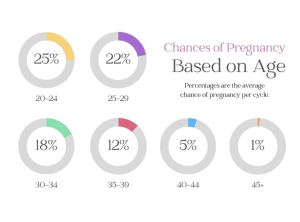
A healthy woman in her mid-20s has a strong chance of becoming pregnant within a year of trying, assuming regular ovulation and no underlying fertility concerns. On average, women in their 20s may have a 20-25% chance of conceiving each menstrual cycle, which is why many pregnancies happen relatively quickly during this stage of life. For women under 30, IVF success is also relatively favorable, at about 25% per cycle on average.
Looking at the chances of getting pregnant by age chart, the 20s consistently show the highest monthly natural fertility rates, while treatment-based success rates follow a separate pattern, and those odds gradually taper through the 30s and 40s.
Egg Quality and Pregnancy Outcomes
Egg quality is typically excellent in the 20s, which plays a major role in successful fertilization and healthy embryo development. Because chromosomal error rates are lower at younger ages, healthy embryo development is better supported, and the risk of miscarriage or genetic disorders is generally lower compared to later decades.
Fertility Challenges That Can Still Occur
Even during peak fertility years, some women experience difficulty conceiving. Age alone doesn’t prevent conditions that affect reproductive health.
Common fertility-related issues in the 20s may include:
- Polycystic Ovary Syndrome (PCOS)
- Polyendocrine Metabolic Ovarian Syndrome (PMOS)
- Endometriosis
- Irregular ovulation or hormone imbalances
- Thyroid disorders
- Male factor infertility
Because fertility involves both partners, difficulty conceiving is not always related to female age or egg health, which is why we may also recommend male fertility tests in the early stages of your journey.
Fertility in Your 30s: Gradual Decline and Key Turning Points
For many women, the 30s are a time of transition when it comes to fertility. While pregnancy is still very possible throughout this decade, subtle biological changes begin to occur.
Many women continue to ovulate regularly, and egg quality is generally good. As hormone levels drop gradually across the decade, ovulation may become slightly less predictable even when periods stay regular. By age 35, the monthly chance of natural pregnancy is around 15% per cycle.
Your 35th Birthday is a Fertility Milestone
Age 35 doesn’t mean fertility stops, but the rate of decline becomes more noticeable. After this point, both egg quantity and egg quality decrease more rapidly.
As egg quality declines, eggs are more likely to have chromosomal abnormalities. This affects fertilization, embryo development, and implantation, and it also increases the risk of miscarriage. While many women do conceive and have healthy pregnancies after 35, it may take longer and require closer monitoring or additional support.
Fertility Testing and Treatment in Your 30s
Because fertility changes accelerate during this decade, earlier evaluation at fertility clinics is often recommended. This can provide insight into:
- Ovarian reserve (including AMH levels)
- Ovulation patterns and hormone balance
- Uterine and tubal health
If treatment is needed, options such as intrauterine insemination (IUI) or in vitro fertilization (IVF) may be recommended depending on individual circumstances, and IVF often begins with fertility medicine to support ovarian stimulation before eggs are collected.
Egg Freezing is a Proactive Option
For women who aren’t ready to start a family but want to keep future options open, egg freezing (cryopreservation) can be an empowering option. Because egg quality is generally higher earlier in your 30s, freezing eggs at this stage may help preserve younger, healthier eggs for use later in life.
How to Improve Fertility in Your 30s and 40s
While age-related changes to egg quantity and quality aren’t reversible, some steps may help support overall reproductive health during this stage:
- Maintain a healthy weight and balanced diet
- Take a prenatal vitamin with folic acid
- Manage blood pressure and other chronic conditions
- Avoid smoking and limit alcohol
- Keep up with regular OBGYN checkups
- Track ovulation to better identify your fertile window
- Consider fertility testing earlier rather than later if you’re planning to conceive
Know What’s Possible with Fertility in Your 40s
As women enter their 40s, the number of remaining eggs is lower, and egg quality continues to decline. This means that the chance of getting pregnant in any given menstrual cycle is reduced compared to the 30s. On average, women in their early 40s may have a lower monthly chance of conception, and it often takes longer to become pregnant naturally.
That said, regular menstrual cycles can still indicate ongoing ovulation, and some women do conceive without medical intervention.
Egg Quality, Miscarriage Risk, and Healthy Pregnancy
Egg quality is one of the most important factors affecting fertility in the 40s. As chromosomal abnormalities become more common with age, there is a higher risk of miscarriage. Age can also raise the risk of pregnancy complications such as gestational diabetes and high blood pressure.
However, many women in their 40s go on to have healthy pregnancies and a healthy baby, particularly when pregnancies are closely monitored and supported by experienced care teams.
It’s also worth noting that advances in genetic testing and prenatal care have improved pregnancy outcomes and provided valuable reassurance for many patients in this age group.
Fertility Care Options Including Assisted Reproductive Technologies in Your 40s
Timely support can make a meaningful difference in your fertility journey. At this age, we create a plan that aligns with your health, goals, and timeline.
- IVF may help identify and transfer embryos with the highest potential for success, but success with your own eggs declines sharply in the mid-40s, and rates for women over 44 are in the low single digits.
- Some patients may explore additional options, such as an egg donor, when their own eggs are unlikely to succeed, since donor-egg IVF can maintain success rates around 50%.
This difference often depends on whether embryos come from eggs of the same age as the patient or from younger donor eggs.
Working with an experienced fertility team can help you better understand your options and move forward with confidence, whether you are just beginning to consider pregnancy or have already been trying to conceive.
Most Commonly Asked Questions About Female Fertility
Most women reach their fertile window roughly 11 to 16 days after the first day of their last period, though this varies depending on cycle length. Ovulation typically occurs around the midpoint of the woman’s fertility cycle, and the days leading up to it — when cervical mucus becomes more fertile, and an egg is preparing for release — offer the best chance of conception.
Tracking ovulation with apps, at-home kits, or basal body temperature can pinpoint this window more precisely, especially for women coming off birth control, whose cycles may take a few months to regulate.
The menstrual cycle has four distinct phases:
- The Menstrual Phase: When the uterine lining sheds
- The Follicular Phase: When follicle-stimulating hormone prompts egg-containing follicles to mature
- Ovulation: When the mature egg is released
- Luteal Phase: When the uterine lining thickens to prepare for a potential pregnancy
If pregnancy doesn’t occur, hormone levels drop, and the cycle begins again.
It can be, though “harder” doesn’t mean impossible, and after 30 some people notice conception takes more time because of age-related infertility. Egg quality declines with age, and this shift in age and fertility tends to become more noticeable after 35.
Many women in their 30s conceive without any issue, but it may take a bit longer, and the chance of pregnancy per cycle is somewhat lower than it was in their 20s. Earlier fertility testing in this decade can offer helpful insight if conception is taking longer than expected.
Women are born with all the eggs they’ll ever have, and that number declines steadily from birth. By her 20s, a woman typically has several hundred thousand eggs remaining, though only a small fraction will ever be ovulated. This is considered the window closest to peak age for women’s fertility, when both egg supply and quality are at their strongest.
By around age 30, roughly 88% of a woman’s original egg supply is already gone, and by 40, that number climbs to about 97%. This steep, ongoing decline is a normal part of aging and is one of the main reasons at what age does fertility decline for a woman is such a common question.
IVF success depends on many factors, including age, ovarian reserve, embryo quality, and diagnosis, so there’s no single number that applies to everyone. Broad averages are about 25% for women under 30, while success for women over 44 using their own eggs is in the low single digits. Generally, per-cycle success rates are highest for women under 35 and decline gradually with age.
A fertility specialist can review your specific situation, including AMH levels, egg quality, and prior IVF cycle history, to give you a more personalized estimate of your odds. Donor-egg IVF can keep success rates near 50% for some patients.
IVF treatment involves several steps:
- Hormone medications stimulate the ovaries to produce multiple eggs
- Those eggs are retrieved in a minor procedure
- The eggs are fertilized with sperm in a lab
Resulting embryos are monitored for several days before one (or more) is transferred into the uterine lining, bypassing the fallopian tubes entirely. This makes IVF a helpful option for women with tubal blockages, diminishing ovarian reserve, or unexplained infertility.
There isn’t a single “best” option. The right choice depends on your age, diagnosis, and goals. Some patients start with less invasive fertility treatments like ovulation induction or IUI, while others move directly to IVF.
The best path is one built around your individual test results and history, which is why a consultation with a fertility specialist is such an important first step.
Fertility treatments cover a range of approaches to help with conception, including:
- Medications, including fertility medicine that regulates or stimulates ovulation
- Intrauterine insemination (IUI)
- In vitro fertilization (IVF)
- Egg freezing (cryopreservation)
- Donor egg or frozen embryos may be considered in some cases
The different types of fertility treatment available mean that most patients, regardless of age or diagnosis, have more than one path forward to explore.
Fertility begins a gradual decline in the early-to-mid 30s. As women age, female fertility declines after 35, driven mainly by decreasing egg quantity and quality. That said, the average age at which women get pregnant has been rising in recent years, and many women conceive naturally well into their late 30s and 40s.
Supporting fertility during this time through OBGYN checkups, managing blood pressure, taking folic acid, maintaining a healthy weight, and avoiding smoking can optimize your outcome. Additionally, pregnancy risks like gestational diabetes and pregnancy complications become more relevant with age, which is why closer monitoring is recommended for women trying to conceive later in life.
Take the Next Step With Alabama Center for Reproductive Medicine
No matter your age or where you are in your fertility journey, you deserve clear answers, compassionate care, and a team that listens. At ACRM, patients receive individualized fertility care designed to support their unique goals, whether that means trying to conceive naturally, exploring fertility treatment options, or gaining a better understanding of their reproductive health, including help understanding IVF cycles, donor-egg treatment, and other fertility options based on age and goals.
Our experienced fertility specialists combine advanced reproductive technology with a thoughtful, patient-first approach to help women and couples at every stage of life. If you have questions about age and fertility or have been struggling to conceive, we’re here to help you explore your options confidently. To schedule an in-depth phone consultation with our team, call (205) 307-0484 or fill out the form on our website and take the next step toward growing your family.